missing translation for 'onlineSavingsMsg'
Learn More
Learn More
Invitrogen™ CD152 (CTLA-4) Monoclonal Antibody (14D3), Brilliant Ultra Violet™ 737, eBioscience™, Invitrogen™
Mouse Monoclonal Antibody
Brand: Invitrogen™ 367-1529-41
This item is not returnable.
View return policy
Description
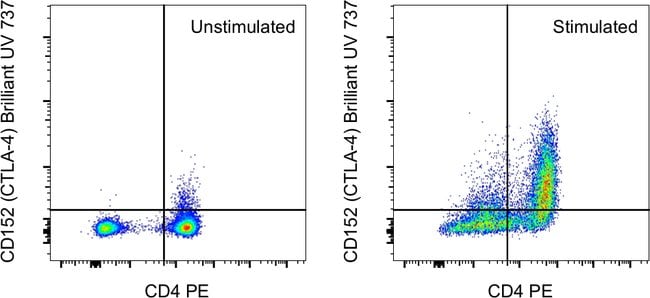
The 14D3 monoclonal antibody reacts with human CD152, also known as CTLA-4. CTLA-4, a protein with structural similarities to CD28, is expressed on activated T cells (activated B cells may also express CTLA-4) and binds the B7 family members, CD80 (B7-1) and CD86 (B7-2), with higher affinity than CD28 does. CTLA-4 and CD28 appear to deliver opposing signals to T cells: while CD28 is a potent costimulator, CTLA-4 restricts the progression of T cells to an activated state by inhibiting IL-2 secretion and cellular proliferation. The cytoplasmic portion of CTLA-4 contains ER retention motifs, resulting in intracellular localization of a large proportion of newly synthesized CTLA-4 in response to TCR signaling. The 14D3 antibody also recognizes rhesus monkey and has inhibitor activity. Applications Reported: This 14D3 antibody has been reported for use in intracellular staining followed by flow cytometric analysis. Applications Tested: This 14D3 antibody has been pre-diluted and tested by intracellular staining followed by flow cytometric analysis of stimulated normal human peripheral blood cells using the Intracellular Fixation & Permeabilization Buffer Set (Product # 88-8824-00). This may be used at 5 μL (0.25 μg) per test. Cell number should be determined empirically but can range from 10^5 to 10^8 cells/test. Brilliant Ultraviolet 737 is a tandem dye that emits at 732 nm and is intended for use on cytometers equipped with an ultraviolet (355 nm) laser.
CTLA4 (Cytotoxic T-Lymphocyte Antigen 4) is a CD28-family receptor expressed on mainly CD4+ T cells. It binds the same ligands as CD28 (CD80 and CD86 on B cells and dendritic cells), but with higher affinity than CD28. However, in contrast to CD28 which enhances cell function when bound at the same time as the T cell receptor, CTLA4 inhbits the T cell and prevents it from functioning. Intracellular CTLA4 is also found in regulatory T cells and may be important to their function.
Specifications
| CD152 (CTLA-4) | |
| Monoclonal | |
| 5 μL/Test | |
| PBS with BSA and 0.09% sodium azide; pH 7.2 | |
| P16410 | |
| CTLA4 | |
| Affinity chromatography | |
| RUO | |
| 1493, 705673 | |
| 4°C, store in dark, DO NOT FREEZE! | |
| Liquid |
| Flow Cytometry | |
| 14D3 | |
| Brilliant Ultraviolet 737 | |
| CTLA4 | |
| ALPS5; CD; CD152; CD152 antigen; CD152 isoform; CD152 protein; CD152 protein precursor; celiac disease 3; CELIAC3; Ctla4; CTLA-4; cytotoxic T lymphocyte associated antigen 4 short spliced form; cytotoxic T-lymphocyte associated protein 4; cytotoxic T-lymphocyte protein 4; cytotoxic T-lymphocyte protein 4 isoform CTLA4-TM; cytotoxic T-lymphocyte-associated antigen 4; cytotoxic T-lymphocyte-associated protein 4; cytotoxic T-lymphocyte-associated serine esterase-4; EGK_04712; GRD4; GSE; ICOS; IDDM12; insulin-dependent diabetes mellitus 12; ligand and transmembrane spliced cytotoxic T lymphocyte associated antigen 4; Ly-56; sCTLA4; soluble form; transmembrane form | |
| Mouse | |
| 25 Tests | |
| Primary | |
| Human, Rhesus Macaque | |
| Antibody | |
| IgG2a κ |
Product Content Correction
Your input is important to us. Please complete this form to provide feedback related to the content on this product.
Product Title
Spot an opportunity for improvement?Share a Content Correction