missing translation for 'onlineSavingsMsg'
Learn More
Learn More
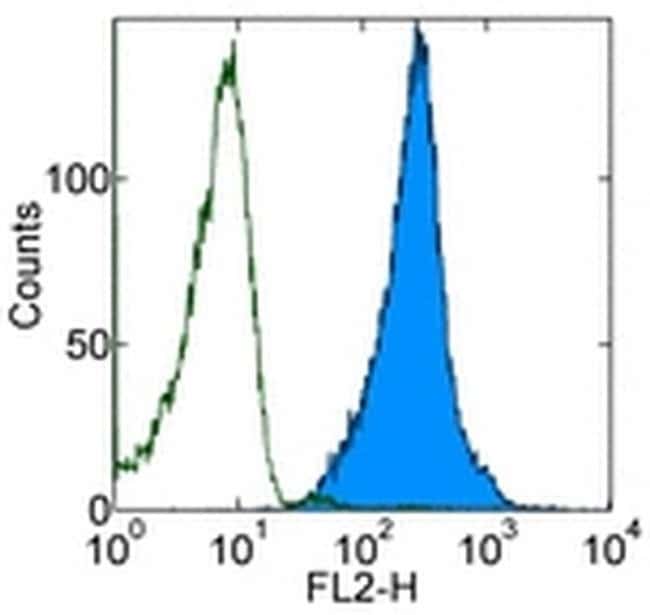
Invitrogen™ CD230 (PrP) Monoclonal Antibody (4D5), PE, eBioscience™

Mouse Monoclonal Antibody
Brand: Invitrogen™ 12-9230-42
This item is not returnable.
View return policy
Description
Description: CD230 (prion protein; PrP^C) is a 35 kD glycoprotein, attached to the cell surface via a GPI-anchor. While the function of CD230 is unclear, prion protein has been the focus of research based on its involvement in transmissible spongiform encephalopathies (TSE), including Creutzfeld-Jakob disease in humans. CD230 undergoes a conformational change in which the cellular PrP^C form is converted to the scrapie PrP^Sc form. This conversion is essential for the infectiousness of prion-based diseases. CD230 is predominantly expressed on the surface of lymphocytes and monocytes, with weak expression on granulocytes and erythrocytes. In platelets, CD230 is expressed primarily intracellularly, and is upregulated to the surface upon activation. Applications Reported: This 4D5 antibody has been reported for use in flow cytometric analysis. Applications Tested: This 4D5 antibody has been pre-titrated and tested. This can be used at 5 μL (0.125 μg) per test. A test is defined as the amount (μg) of antibody that will stain a cell sample in a final volume of 100 μL. Cell number should be determined empirically but can range from 10^5 to 10^8 cells/test. Excitation: 488-561 nm; Emission: 578 nm; Laser: Blue Laser, Green Laser, Yellow-Green Laser. Filtration: 0.2 μm post-manufacturing filtered.
Human prion protein (PrP), also known as PRNP, is a ubiquitously expressed GPI-anchored cell surface glycoprotein associating with lipid raft components and functioning as a signaling molecule. PrP plays a role in apoptosis in a cell context-dependent manner, is involved in proliferation of epithelial cells and in distribution of junction-associated proteins in human enterocytes. Conversion of this normal cellular prion protein (PrPc) into an abnormal conformer (PrPSc) is the crucial step associated with triggering the pathogenesis of the prion neurodegenerative disorders, such as the Creutzfeld-Jakob disease (CJD). Whereas PrPc is rich in alpha-helices, the PrPSc form has higher content of beta-sheets and is resistant to proteinase K.
Specifications
| CD230 (PrP) | |
| Monoclonal | |
| 5 μL/Test | |
| PBS with BSA and 0.09% sodium azide; pH 7.2 | |
| F7VJQ1, P04156 | |
| PRNP | |
| Affinity chromatography | |
| RUO | |
| 5621 | |
| 4°C, store in dark, DO NOT FREEZE! | |
| Liquid |
| Flow Cytometry | |
| 4D5 | |
| PE | |
| PRNP | |
| AA960666; AI325101; Alternative prion protein; alternative prion protein; major prion protein; AltPrP; ASCR; BSE; CD230; CD230 antigen; CJD; GSS; KURU; major prion protein; major prion protein; alternative prion protein; major scrapie-associated fibril protein 1; MGC26679; p27-30; PK resistant core; prion protein; prion protein (p27-30) (Creutzfeldt-Jakob disease, Gerstmann-Strausler-Scheinker syndrome, fatal familial insomnia); prion protein precursor; prion protein precursor PrP; prion protein PrP; prion protein variant a; prion protein variant b; prion protein, PrP; prion protein, structural; prion-related protein; PRIP; Prn; Prn-i; Prnp; Prn-p; PrP; PrP>C>; PrP27-30; PrP33-35C; PrPc; PrPSc; Sinc; SIP; TSE | |
| Mouse | |
| 100 Tests | |
| Primary | |
| Human | |
| Antibody | |
| IgG1 κ |
Product Content Correction
Your input is important to us. Please complete this form to provide feedback related to the content on this product.
Product Title
Spot an opportunity for improvement?Share a Content Correction