missing translation for 'onlineSavingsMsg'
Learn More
Learn More
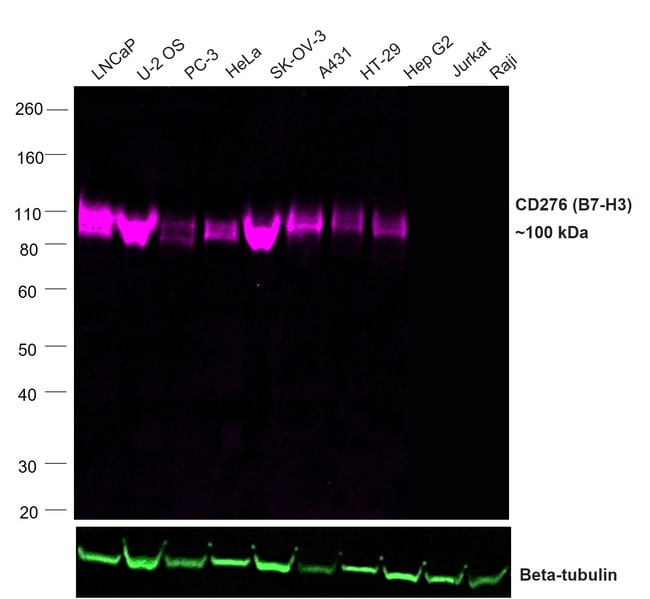
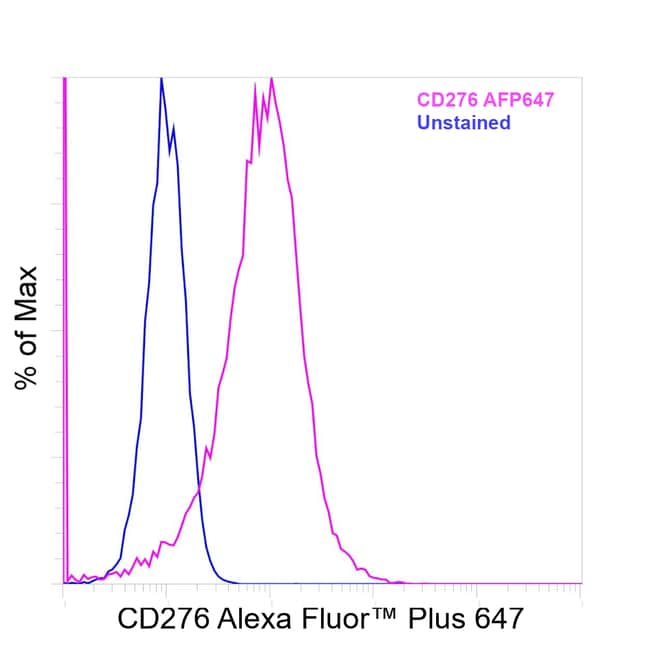
Invitrogen™ CD276 (B7-H3) Recombinant Rat Monoclonal Antibody (M3.2D7), Alexa Fluor™ Plus 647
Rat Recombinant Monoclonal Antibody
Brand: Invitrogen™ 740074TP647XS
This item is not returnable.
View return policy
Description
Alexa Fluor™ Plus recombinant antibodies are conjugated using new, proprietary dye chemistry so you can generate stunning data. Alexa Fluor™ Plus antibodies represent an advancement in fluorescent conjugate technology. Alexa Fluor™ Plus antibodies provide brighter signal compared to leading Alexa Fluor™ antibodies, providing you with better signal-to-noise for your critical experiments. These antibodies show better specificity and lot-to-lot consistency as these are recombinant antibodies, generated by cloning specific genes for the desired antibodies into an expression vector and expressed in vitro. Using conjugate solutions: Centrifuge the protein conjugate solution briefly in a microcentrifuge before use; add only the supernatant to the experiment. This step will help eliminate any protein aggregates that may have formed during storage, thereby reducing nonspecific background staining. Applications Tested: This M3.2D7 antibody has been tested by flow cytometry and western blot. This may be used for flow cytometry at 1 μg per test. A test is defined as the amount (μg) of antibody that will stain a cell sample in a final volume of 100 μL. Cell number should be determined empirically but can range from 10^5 to 10^8 cells/test. It is recommended that the antibody be carefully titrated for optimal performance in the assay of interest. Excitation: 658 nm; Emission: 675 nm; Laser: Red Laser Filtration: 0.2 μm post-manufacturing f...
CD276 is a member of the B7 family of co-stimulatory molecules also known as B7-H3. CD276 is a type I transmembrane protein that induces the proliferation of CD4+ and CD8+ T cells, enhances the generation of cytotoxic T cells and selectively stimulates the production of interferon gamma. Expression of CD276 can be induced on dendritic cells and monocytes by inflammatory cytokines, and is also widely expressed in peripheral tissues including the heart, kidney, testis and colon. In humans, CD276 exists as two isoforms which result from gene duplication and differential splicing. CD276 is reported to have therapeutic potential for the regulation of cell-mediated immune responses to cancer, particularly in conjunction with anti-angiogenic therapy.
Specifications
| CD276 (B7-H3) | |
| Recombinant Monoclonal | |
| 1.0 mg/mL | |
| Proprietary buffer with 0.008% Bromonitrodioxane, 0.008% Methylisothiazolone; pH 6.8 | |
| Q5ZPR3, Q8VE98 | |
| CD276 | |
| Affinity chromatography | |
| RUO | |
| 102657, 80381 | |
| 4°C, store in dark, DO NOT FREEZE! | |
| Liquid |
| Flow Cytometry, Western Blot | |
| M3.2D7 | |
| Alexa Fluor Plus 647 | |
| CD276 | |
| 4Ig-B7-H3; 6030411F23Rik; AU016588; B7 homolog 3; B7h3; B7-H3; B7RP-2; CD276; CD276 antigen; CD276 molecule; CD276 molecule tv1; costimulatory molecule; PSEC0249; sB7 H3; sB7H3; sCD276; soluble B7 H3; soluble B7H3; soluble CD276; UNQ309/PRO352 | |
| Rat | |
| 20 μL | |
| Primary | |
| Human, Mouse | |
| Antibody | |
| IgG2a |
Product Content Correction
Your input is important to us. Please complete this form to provide feedback related to the content on this product.
Product Title
Spot an opportunity for improvement?Share a Content Correction