Learn More

Description
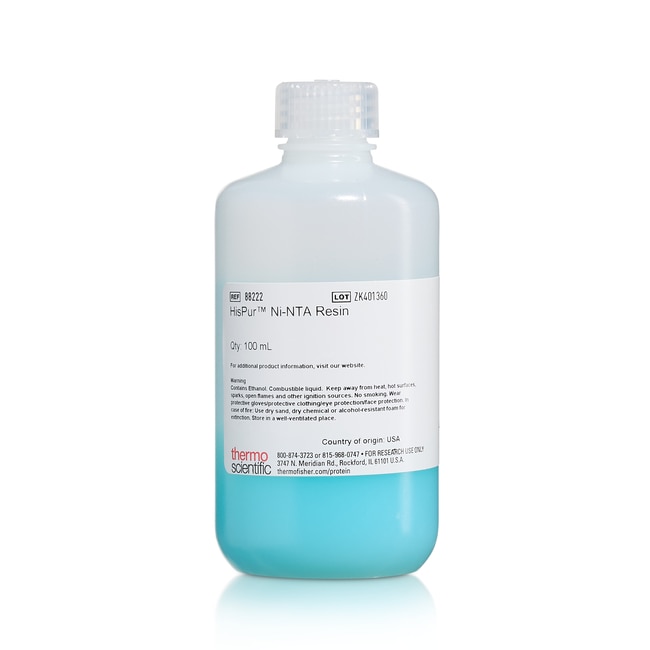
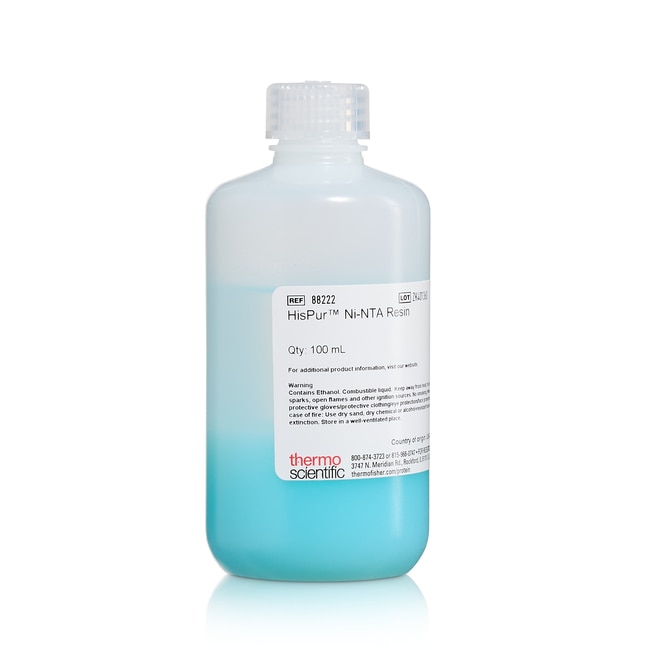
Perform routine affinity purification of His-tagged fusion proteins with Thermo Scientific™ HisPur Ni-NTA Resin, a high-capacity, high-performance nickel-IMAC resin.
The specially prepared nickel-NTA support consists of beaded agarose derivatized with the nitrilotriacetic acid (NTA) chelation moiety and loaded with divalent nickel ions (Ni2+). The immobilized metal affinity chromatography (IMAC) resin provides exceptional binding capacity and performance for recombinant His-tagged protein purification.
HisPur Ni-NTA Resin is available in several package sizes of resin slurry, three sizes of centrifuge-ready columns, complete purification kits, two sizes of FPLC-ready chromatography cartridges, and 96-well filter plates for high through-put needs. With these options, high-yield His-tag protein purification is possible at nearly any scale.
Highlights:
- High capacity – bind up to 60mg of 6xHis-tagged protein per milliliter of resin
- Versatile – purify proteins using native or denaturing conditions
- Compatible – use with Thermo Scientific Cell Lysis Reagents and a variety of buffer additives
- Flexible – available in multiple formats including bulk resin, spin columns and chromatography cartridges
- Cost-effective – reuse the same batch of resin at least five times
- Easy to use – pre-formulated buffers available for kit formats
Available Formats:
- Resin Slurries – crosslinked 6% beaded agarose; 10mL, 100mL, 500mL bottles
- Spin Columns – 0.2mL (microcentrifuge), 1mL, 3mL columns
- Purification Kits – complete kits in all three column sizes
- Chromatography Cartridges – compatible with automated liquid chromatography systems and with syringe processing
- Bulk and Custom – let us know your needs for bulk HisPur Ni-NTA Resin
Includes:
Kits contain HisPur Ni-NTA Columns (store at 4°C)

Specifications
Specifications
| Capacity (Metric) | Up to 60 mg of 6xHis-Tagged Protein Binding per mL Resin |
| Description | HisPur Ni-NTA Resin |
| Content And Storage | Store at 4°C |
| Form | Liquid Suspension |
| Product Line | HisPur |
| Quantity | 100 mL |
| Target | His-Tagged Protein |
| Type | Resin |
| Stationary Phase | Divalent Nickel, Metal Chelate |
| Format | Bottle |
| Show More |
Frequently Asked Questions (FAQs)
The resin can be re-used at least five times; this is also for the resin in the plates. Regeneration is possible using this procedure (https://assets.thermofisher.com/TFS-Assets%2FLSG%2Fmanuals%2FMAN0011700_HisPur_NiNTA_Resin_UG.pdf) Since the resin bed volume in each well is 50 µL, you can use 250 µL twice to give a total of 10 resin-bed volume.
Please refer to page 2 (buffer preparation) and page 3 (procedure) of the manual (https://assets.thermofisher.com/TFS-Assets/LSG/manuals/MAN0011700_HisPur_NiNTA_Resin_UG.pdf) for information regarding bead regeneration.
ProBond and Ni-NTA beads can be used in FPLC columns. However, the beads can only withstand low pressure (~43.5 psi max).
Both systems are qualified by purifying 2 mg of myoglobin protein on a column and performing a Bradford assay. Protein recovery must be 75% or higher.
Nickel has a higher affinity for histidines than does cobalt. It binds multiple histidines more tightly than cobalt, and requires more stringent conditions than is necessary for cobalt. The lower affinity of cobalt for multiple histidines typically results in less nonspecific binding of histidine-rich proteins that lack a his-tag compared to nickel resins.
HisPur Ni-NTA resin has a high capacity of up to 60 mg of 6xHis-tagged protein per milliliter. It is a versatile resin that can work under both native and denaturing conditions, and can also be used with a variety of lysis reagents and buffer additives.
HisPur Cobalt resin utilizes proprietary tetradentate chelating resin charged with cobalt. This system recovers highly purified protein with lower imidazole concentrations and has low metal leeching properties.
Safety and Handling

- HisPur Ni-NTA Resin
- Danger
- LONG-TERM AQUATIC HAZARD Chronic 3
- Carcinogenicity Category 1A
- Reproductive toxicity Category 1B
- Respiratory sensitiser Category 1
- Skin sensitiser Category 1
- Specific target organ toxicity after repeated exposure Category 2
- H317-May cause an allergic skin reaction.
- H334-May cause allergy or asthma symptoms or breathing difficulties if inhaled.
- H350-May cause cancer.
- H360D-May damage the unborn child.
- H373-May cause damage to organs.
- H412-Harmful to aquatic life with long lasting effects.
- P260-Do not breathe dust/fume/gas/mist/vapours/spray.
- P264-Wash thoroughly after handling.
- P280-Wear protective gloves/protective clothing/eye protection/face protection.
- P301+P310-IF SWALLOWED: Immediately call a POISON CENTER/doctor /
- P405-Store locked up.
- P501b-Dispose of contents/container in accordance with local/regional/national/international regulations.
- MIXTURE LIST-Contain: sulphuric acid
For Research Use Only. Not for use in diagnostic procedures.
By clicking Submit, you acknowledge that you may be contacted by Fisher Scientific in regards to the feedback you have provided in this form. We will not share your information for any other purposes. All contact information provided shall also be maintained in accordance with our Privacy Policy.