missing translation for 'onlineSavingsMsg'
Learn More

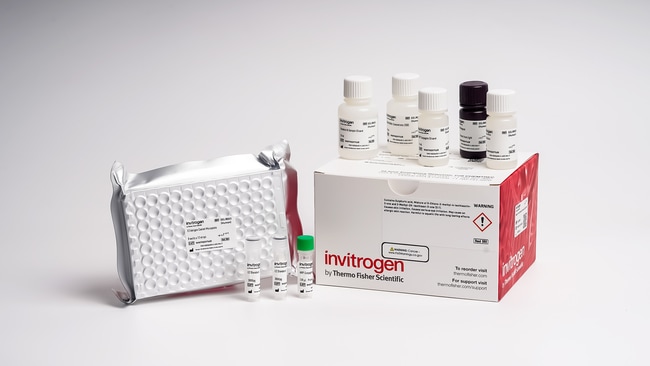
Invitrogen™ Human CEA Rapid ELISA Kit

Product Code. 30829956
Change view
Click to view available options
Quantity:
96 Tests
1 product options available for selection
Product selection table with 1 available options. Use arrow keys to navigate and Enter or Space to select.
Product Code. Quantity
30829956 96 Tests
Use arrow keys to navigate between rows. Press Enter or Space to select a product option. 1 options available.
1 options
This item is not returnable. View return policy
Product Code. 30829956 Supplier Invitrogen™ Supplier No. EELR027

Please to purchase this item. Need a web account? Register with us today!

This item is not returnable. View return policy

ELISA

The Human Carcinoembryonic Antigen (CEA) ELISA quantitates CEA in serum and plasma. Principle of the method The Human CEA solid phase sandwich ELISA (enzyme linked immunosorbent assay) is designed to measure the amount of the target bound between a matched antibody pair. A target specific antibody has been pre coated in the wells of the supplied microplate. Samples, standards, or controls are then added into these wells, where Human CEA in the samples (or standards) binds to the immobilized (capture) antibody. The sandwich is formed by the addition of the second (detector) HRP linked antibody specific for Human CEA. Excess conjugate and unbound sample or standard are washed away from the plate. The substrate solution is added to each well, and the enzyme substrate reaction is terminated by the addition of a stop solution, turning the color yellow. The optical density (OD) is measured spectrophotometrically at a wavelength of 450±2 nm. The intensity of this signal is directly proportional to the concentration of Human CEA present in the original specimen, which is determined by comparing the OD of the samples to the standard curve. Achieve fast and reliable results in just 90 minutes with our Rapid ELISA kit, featuring a streamlined protocol that requires only one wash step. Rigorous validation: Each manufactured lot of this ELISA kit is quality tested for criteria such as sensitivity, specificity, precision, and lot-to-lot consistency. See manual for more inf...

CEA (Carcino Embryonic Antigen, CD66e) is synthesized during development in the fetal gut, and re-expressed in increased amounts in intestinal carcinomas and several other tumors. CEA is a member of carcinoembryonic antigens, immunoglobulin supergene family and consists of a single N domain (structural homology to the immunoglobulin variable) and six immunoglobulin constant-like A (A1, A2, A3) and B domains (B1, B2, B3). Antibodies to CEA are useful in identifying the origin of various metastatic adenocarcinomas and in distinguishing pulmonary adenocarcinomas (60 to 70% are CEA+) from pleural mesotheliomas (rarely or weakly CEA+). CEA is a member of a large family of glycoproteins, a useful tumor marker for adenocarcinoma, and found in adenocarcinomas of endodermally derived digestive system epithelium and fetal colon. Two subgroups of the CEA family, the CEA cell adhesion molecules and the pregnancy-specific glycoproteins, are located within a 1.2 Mb cluster on the long arm of chromosome 19. Eleven pseudogenes of the CEA cell adhesion molecule subgroup are also found in the cluster. CEA was originally described in bile ducts of liver as biliary glycoprotein. Subsequently, CEA was found to be a cell-cell adhesion molecule detected on leukocytes, epithelia, and endothelia. The encoded protein mediates cell adhesion via homophilic as well as heterophilic binding to other proteins of the subgroup. Multiple cellular activities have been attributed to the encoded protein, including roles in the differentiation and arrangement of tissue three-dimensional structure, angiogenesis, apoptosis, tumor suppression, metastasis, and the modulation of innate and adaptive immune responses. Multiple transcript variants encoding different isoforms have been reported, but the full-length nature of all variants has not been defined.
TRUSTED_SUSTAINABILITY

Specifications

Accession Number P06731
Assay Range 0.78-50 ng/mL
Assay Sensitivity 0.47 ng/mL
Conjugate HRP
Immunoassay Kit Format Coated ELISA Kit
Product Type ELISA
Sample Type Plasma, Serum
Target Species Human
For Use With (Equipment) Absorbance Microplate Reader
Gene Alias 1600029H12Rik; Carcinoembryonic antigen; carcinoembryonic antigen related cell adhesion molecule 5; carcinoembryonic antigen-related cell adhesion molecule 5; CD66e; CEA; CEACAM5; Meconium antigen 100; OTTHUMP00000199033; pregnancy-specific glycoprotein 30; Psg30; sCD66e; soluble CD66e1600029H12Rik; Carcinoembryonic antigen; carcinoembryonic antigen related cell adhesion molecule 5; carcinoembryonic antigen-related cell adhesion molecule 5; CD66e; CEA; CEACAM5; Meconium antigen 100; OTTHUMP00000199033; pregnancy-specific glycoprotein 30; Psg30; sCD66e; soluble CD66e;
Gene ID (Entrez) 1048
Gene Symbol Ceacam5
Interassay CV <10%
Intraassay CV <10%
Kit Contents Pre-coated 96 well plate, Standard, HRP Conjugate, Standard & Sample Diluent, HRP Conjugate Diluent, Wash Buffer, TMB Substrate, Stop Solution, Plate Sealer, Standard, HRP Conjugate, Standard & Sample Diluent, HRP Conjugate Diluent, Wash Buffer, TMB Substrate, Stop Solution, Plate Sealer
Label or Dye HRP
Quantity 96 Tests
Regulatory Status RUO
Sample Volume Plasma 50 μL, Serum 50 μL
Shipping Condition Wet or Dry Ice
Storage Requirements Refer to product documentation for component specific storage temperature.
Target CD66e (CEACAM5)
Test Time 15 min
Total Assay Time 1 hr 30 min
Show More Show Less
Product Title
Select an issue

By clicking Submit, you acknowledge that you may be contacted by Fisher Scientific in regards to the feedback you have provided in this form. We will not share your information for any other purposes. All contact information provided shall also be maintained in accordance with our Privacy Policy.