missing translation for 'onlineSavingsMsg'
Learn More
Learn More
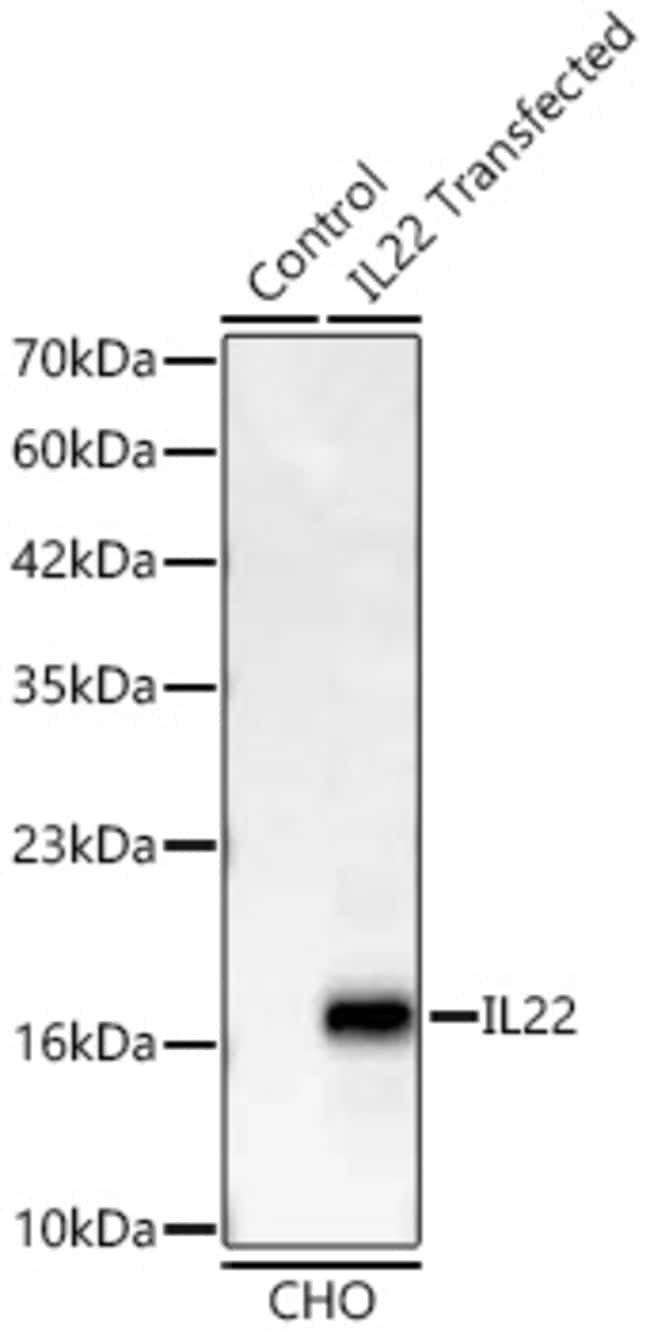
Invitrogen™ IL-22 Recombinant Rabbit Monoclonal Antibody (0E3L7)
Rabbit Recombinant Monoclonal Antibody
176.00€ - 436.00€
Specifications
| Antigen | IL-22 |
|---|---|
| Clone | 0E3L7 |
| Concentration | 1.86 mg/mL |
| Content And Storage | -20°C, Avoid Freeze/Thaw Cycles |
| Applications | ELISA, Western Blot |
| Product Code | Brand | Quantity | Price | Quantity & Availability | |||||
|---|---|---|---|---|---|---|---|---|---|
| Product Code | Brand | Quantity | Price | Quantity & Availability | |||||
|
30284358
|
Invitrogen™
MA558161 |
20 μL |
176.00€
20µL |
Please sign in to purchase this item. Need a web account? Register with us today! | |||||
|
30283422
|
Invitrogen™
MA558162 |
100 μL |
436.00€
100µL |
Please sign in to purchase this item. Need a web account? Register with us today! | |||||
Description
Immunogen sequence: LPVNTRCKLE VSNFQQPYIV NRTFMLAKEA SLADNNTDVR LIGEKLFRGV SAKDQCYLMK QVLNFTLEDV LLPQSDRFQP YMQEVVPFLT KLSNQLSSCH ISGDDQNIQK NVRRLKETVK KLGESGEIKA IGELDLLFMS LRNACV.
IL-22 also known as IL-10-related T-cell derived inducible factor, is an alpha helical cytokine and is considered a member of the IFN-IL-10 family, which includes IL-19, IL-20, IL-24, IL-26, IL-28, IL-29, and the type I and II interferons. IL-22 is produced mainly by activated T cells and NK cells. In humans, the IL-22 gene is located on the q arm of chromosome 12, and is structurally related to IL10. IL-22 acts by engaging the heterodimeric receptor complex consisting of primary receptor IL-22R1 and accessory receptor IL-10R2. IL-22R1 also binds IL-20 and IL-24; IL-10R2 also binds IL-10, IL-27, IL-28, and IL-29. Binding of IL-22 to its receptor complex induces signal transduction, particularly via the JAK-STAT pathway. In addition to the membrane-bound IL-22R1/IL-10R2 complex, a soluble single-chain IL-22 receptor termed IL-22BP has been found to antagonize IL-22 binding and signaling. IL-22 appears not to directly influence immune cells, and major targets of the cytokine appear to be nonimmune cells, such as cells of the skin, digestive and respiratory system, as well as hepatocytes, and keratinocytes. IL-22 has been described as an effector cytokine of the Th17 lineage. Along with IL-17A and IL-17F, IL-22 regulates genes associated with innate immunity of the skin. IL-17A, IL-17F and IL-22 are all co-expressed by Th17 cells, however, they are differentially regulated. The effects of IL-22 include induction of acute phase reactants and antimicrobial proteins, as well as increasing the mobility of keratinocytes. IL-22 is highly expressed during chronic inflammation, and found to activate intracellular kinases and transcription factors. IL-22 is critical for host defense against infections of extracellular pathogens, and promotes wound-healing responses. IL-22 is upregulated in activated T cells. IL-22 has been reported to mediate IL-23-induced acanthosis and dermal inflammation through activation of STAT3.Specifications
| IL-22 | |
| 1.86 mg/mL | |
| ELISA, Western Blot | |
| Unconjugated | |
| Rabbit | |
| RUO | |
| PBS with 0.05% BSA, 50% glycerol and 0.09% sodium azide; pH 7.3 | |
| Q9JJY9 | |
| 50929 | |
| Recombinant fusion protein containing a sequence corresponding to amino acids 34-179 of mouse IL22 (NP_058667.1). | |
| Antibody |
| 0E3L7 | |
| -20°C, Avoid Freeze/Thaw Cycles | |
| Recombinant Monoclonal | |
| Liquid | |
| IgG | |
| Mouse | |
| IL22 | |
| Cytokine Zcyto18; EGK_03903; il 22; IL-10-related T-cell-derived inducible factor; IL-10-related T-cell-derived-inducible factor; IL-21; IL22; IL-22; Il22a; IL-22a; IL-D110; ILN; ILTIF; IL-TIF; ILTIF alpha; IL-TIF alpha; ILTIFa; Interleukin; interleukin 10-related T cell-derived inducible factor; interleukin 22; Interleukin22; interleukin-22; Interleukin-22a; RGD1561292; TIFa; TIFIL-23; UNQ3099/PRO10096; ZCYTO18 | |
| IL22 | |
| Primary | |
| Protein A |
Spot an opportunity for improvement?Share a Content Correction
Product Content Correction
Your input is important to us. Please complete this form to provide feedback related to the content on this product.
Product Title