missing translation for 'onlineSavingsMsg'
Learn More
Learn More
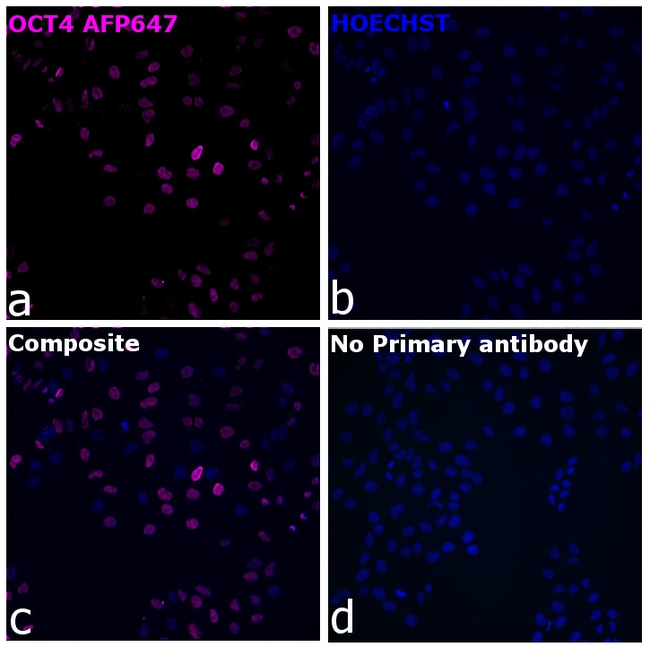
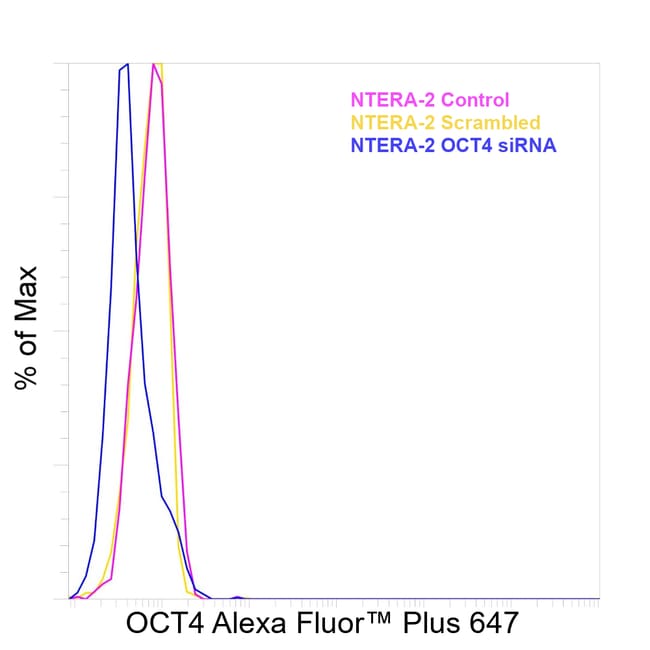
Invitrogen™ OCT4 Recombinant Rabbit Monoclonal Antibody (3H8L6), Alexa Fluor™ Plus 647
Rabbit Recombinant Monoclonal Antibody
195.00€ - 338.00€
Specifications
| Antigen | OCT4 |
|---|---|
| Clone | 3H8L6 |
| Concentration | 1.0 mg/mL |
| Content And Storage | 4°C, store in dark, DO NOT FREEZE! |
| Applications | Flow Cytometry, Immunocytochemistry |
| Product Code | Brand | Quantity | Price | Quantity & Availability | |||||
|---|---|---|---|---|---|---|---|---|---|
| Product Code | Brand | Quantity | Price | Quantity & Availability | |||||
|
30485047
|
Invitrogen™
701756RP647 |
50 μL |
338.00€
50µL |
Please sign in to purchase this item. Need a web account? Register with us today! | |||||
|
30484859
|
Invitrogen™
701756RP647XS |
20 μL |
195.00€
20µL |
Please sign in to purchase this item. Need a web account? Register with us today! | |||||
Description
Alexa Fluor™ Plus recombinant antibodies are conjugated using new, proprietary dye chemistry so you can generate stunning data. Alexa Fluor™ Plus antibodies represent an advancement in fluorescent conjugate technology. Alexa Fluor™ Plus antibodies provide brighter signal compared to leading Alexa Fluor™ antibodies, providing you with better signal-to-noise for your critical experiments. These antibodies show better specificity and lot-to-lot consistency as these are recombinant antibodies, generated by cloning specific genes for the desired antibodies into an expression vector and expressed in vitro. Using conjugate solutions: Centrifuge the protein conjugate solution briefly in a microcentrifuge before use; add only the supernatant to the experiment. This step will help eliminate any protein aggregates that may have formed during storage, thereby reducing nonspecific background staining. Applications Tested: This 3H8L6 antibody has been tested by immunocytochemistry and flow cytometric analysis of NTERA-2 cells. This may be used for immunocytochemistry at 10 μg/mL and for flow cytometry at less than or equal to 0.5 μg per test. A test is defined as the amount (μg) of antibody that will stain a cell sample in a final volume of 100 μL. Cell number should be determined empirically but can range from 10^5 to 10^8 cells/test. It is recommended that the antibody be carefully titrated for optimal performance in the assay of interest. Excitatio...
POU5F1, also commonly known as Oct-4, is a maternally expressed octamer-binding protein that was the first transcription factor described for the early stages of development. The role of POU5F1 in embryonic development suggested that it might be useful in the creation of stem cells that might be useful in cell replacement therapies in the treatment of several degenerative diseases. Artificial stem cells, termed induced pluripotent stem (iPS) cells, can be created by expressing POU5F1 and the transcription factors Sox2, Klf4 and Lin28 along with c-Myc in mouse fibroblasts. More recently, experiments have demonstrated that iPS cells could be generated using expression plasmids expressing POU5F1, Sox2, KlfF4 and c-Myc, eliminating the need for virus introduction, thereby addressing a safety concern for potential use of iPS cells in regenerative medicine.Specifications
| OCT4 | |
| 1.0 mg/mL | |
| Flow Cytometry, Immunocytochemistry | |
| Alexa Fluor Plus 647 | |
| Rabbit | |
| RUO | |
| Proprietary buffer with 0.008% Bromonitrodioxane, 0.008% Methylisothiazolone; pH 6.8 | |
| Q01860 | |
| 5460 | |
| Protein corresponding to Human POU5F1 (aa 1-360). | |
| Antibody |
| 3H8L6 | |
| 4°C, store in dark, DO NOT FREEZE! | |
| Recombinant Monoclonal | |
| Liquid | |
| IgG | |
| Human | |
| POU5F1 | |
| 2-Oct; 3-Oct; 4-Oct; cb197; chunp6868; DADB-104B20.2; etID49452.21; gp9; gp-9; HGNC:9221; homeobox protein; lymphoid-restricted immunoglobulin octamer-binding protein NF-A2; MGC22487; NF-A3; Oct2; Oct-2; Oct2a; Oct2b; OCT3; Oct-3; Oct3/4; Oct-3/4; OCT4; Oct-4; Octamer-binding protein 2; octamer-binding protein 3; Octamer-binding protein 4; octamer-binding transcription factor 2; Octamer-binding transcription factor 3; OTF2; OTF-2; OTF3; Otf-3; Otf3g; Otf3-rs7; Otf4; Otf-4; OTTHUMP00000221150; OTTHUMP00000221151; POU class 2 homeobox 2; POU class 5 homeobox 1; POU class 5 homeobox 1 transcript variant OCT4B1; POU class 5 homeobox 1 transcript variant OCT4B2; POU class 5 homeobox 1 transcript variant OCT4B3; POU class 5 homeobox 1 transcript variant OCT4B4; POU class 5 homeobox 1 transcript variant OCT4B5; POU class 5 homeobox 1 transcript variant OCT4B6; POU domain class 5 transcription factor 1; POU domain gene 2; POU domain protein 2; POU domain transcription factor OCT4; POU domain, class 2, transcription factor 2; POU domain, class 5, transcription factor 1; POU domain, class 5, transcription factor 3; pou2; pou-2; POU2F2; Pou5f1; pou5f1 protein; pou5f3; POU-type homeodomain-containing DNA-binding protein; spg; spg/pou2; spiel-ohne-grenzen; spiel-ohne-grenzen/pou2; wu:fd18d06 | |
| POU5F1 | |
| Primary | |
| Protein A |
Spot an opportunity for improvement?Share a Content Correction
Product Content Correction
Your input is important to us. Please complete this form to provide feedback related to the content on this product.
Product Title