missing translation for 'onlineSavingsMsg'
Learn More
Learn More
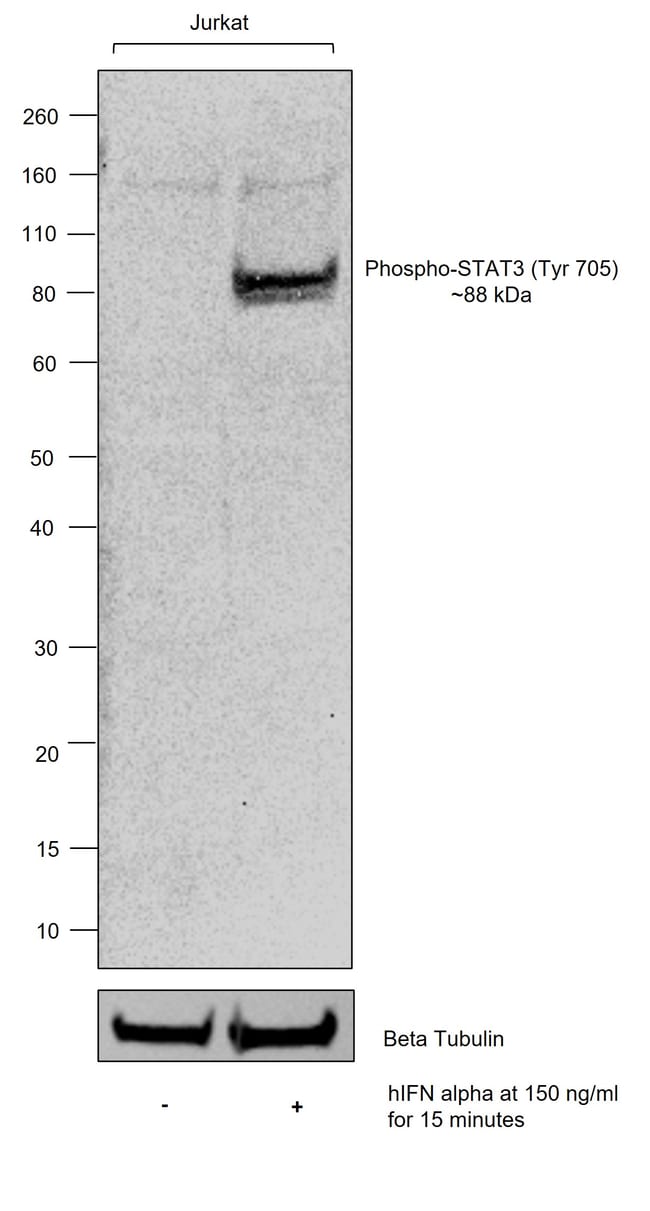
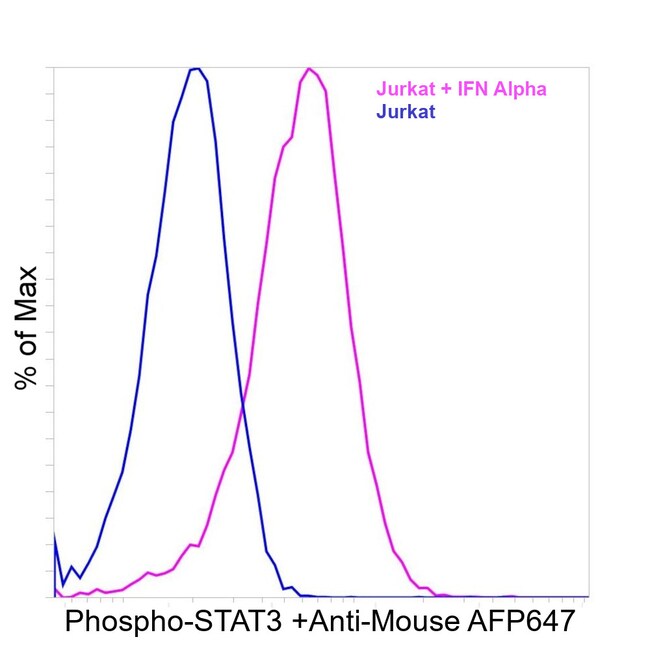
Invitrogen™ Phospho-STAT3 (Tyr705) Recombinant Mouse Monoclonal Antibody (LUVNKLA)
Mouse Recombinant Monoclonal Antibody
195.00€ - 359.00€
Specifications
| Antigen | Phospho-STAT3 (Tyr705) |
|---|---|
| Clone | LUVNKLA |
| Concentration | 1.0 mg/mL |
| Content And Storage | Store at 4°C short term. For long term storage, store at -20°C, avoiding freeze/thaw cycles. |
| Applications | Flow Cytometry, Western Blot |
| Product Code | Brand | Quantity | Price | Quantity & Availability | |||||
|---|---|---|---|---|---|---|---|---|---|
| Product Code | Brand | Quantity | Price | Quantity & Availability | |||||
|
30484938
|
Invitrogen™
740067M |
100 μL |
359.00€
100µL |
Please sign in to purchase this item. Need a web account? Register with us today! | |||||
|
30484920
|
Invitrogen™
740067MXS |
20 μL |
195.00€
20µL |
Please sign in to purchase this item. Need a web account? Register with us today! | |||||
Description
Recombinant mouse monoclonal antibodies are produced using in vitro expression systems. Recombinant antibodies are produced using specific genes that code for the desired antibodies. These genes are cloned into an expression vector and expressed in vitro. The advantages of recombinant antibodies include better specificity and lot-to-lot consistency. It is recommended that the antibody be carefully titrated for optimal performance in the assay of interest.
STAT3 belongs to the family of STAT (signal transducers and activators of transcription) proteins which are phosphorylated by receptor associated kinases, translocate to the nucleus, and act as transcription factors in response to cytokines and growth factors. Coactivators such as CREB-binding protein are required for the transcriptional activation by STAT3. STAT3 can also be activated by Interferon-alpha, Interferon-gamma, EGF, PDGF and IL6. Phosphorylation on tyrosine 705 by JAK1 and JAK2 is essential for STAT3 dimer formation, nuclear translocation, and DNA binding activity. In humans, the STAT3 gene is located on the q arm of chromosome 17. STAT3 has been shown to be activated by IFN-alpha but not IFN-beta. The transcription factors associated with STAT3 are c-Jun and cyclic AMP-responsive enhancer binding protein (CREB). STAT3 mediates the expression of a variety of genes in response to cell stimuli, and thus plays a key role in many cellular processes such as cell growth and apoptosis. The small GTPase Rac1 has been shown to bind and regulate the activity of STAT3 while the PIAS3 protein is a specific inhibitor of STAT3. Three alternatively spliced transcript variants encoding distinct isoforms of STAT3 have been described. Deletion of the STAT3 gene in knock-out mice was lethal at the early embryonic stage.Specifications
| Phospho-STAT3 (Tyr705) | |
| 1.0 mg/mL | |
| Flow Cytometry, Western Blot | |
| Unconjugated | |
| Mouse | |
| RUO | |
| PBS with 0.09% sodium azide; pH 7.4 | |
| P40763, P42227 | |
| 20848, 6774 | |
| Primary | |
| Protein A/G |
| LUVNKLA | |
| Store at 4°C short term. For long term storage, store at -20°C, avoiding freeze/thaw cycles. | |
| Recombinant Monoclonal | |
| Liquid | |
| IgG2b κ | |
| Human, Mouse | |
| STAT3 | |
| 1110034C02Rik; acute phase response factor; acute-phase response factor; ADMIO; ADMIO1; APRF; AW109958; DNA-binding protein APRF; FLJ20882; HIES; MGC16063; signal transducer and activator of transcription 3; signal transducer and activator of transcription 3 (acute-phase response factor); signal transducer; activator of transcription; acute-phase response factor; signal transduction and activation of transcription 3; STAT; STAT3; STAT-3; stat3 protein; STAT3b1; STAT3b2; transcription factor; Unknown (protein for MGC:128731); wu:fc15d02; wu:fl59g06; z-Stat3 | |
| STAT3 | |
| Antibody |
Spot an opportunity for improvement?Share a Content Correction
Product Content Correction
Your input is important to us. Please complete this form to provide feedback related to the content on this product.
Product Title