missing translation for 'onlineSavingsMsg'
Learn More

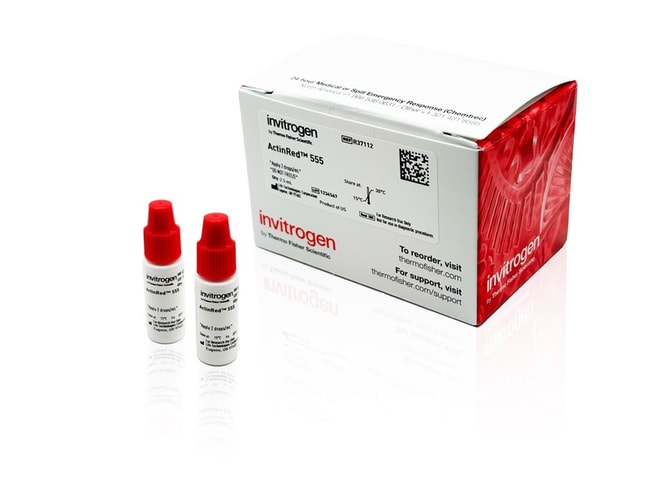
Invitrogen™ ReadyProbes™ F-Actin Labeling Reagents

Product Code. 15119325
Change view
Click to view available options
Dye Type:
Alexa Fluor™ 488
TRITC (Tetramethylrhodamine Isothiocyanate)
Excitation Wavelength Range:
498/520
552/577
Unit Size:
5mL
Each
2 product options available for selection
Product selection table with 2 available options. Use arrow keys to navigate and Enter or Space to select.
Product Code. Dye Type Excitation Wavelength Range unitSize
15119325 TRITC (Tetramethylrhodamine Isothiocyanate) 552/577 Each
14879680 Alexa Fluor™ 488 498/520 5mL
Use arrow keys to navigate between rows. Press Enter or Space to select a product option. 2 options available.
2 options
This item is not returnable. View return policy
Product Code. 15119325 Supplier Invitrogen™ Supplier No. R37112
  • ONLINE EXCLUSIVE PRICE
    336.00€
    315.65€ / 5mL
    Save 20.35€
    6% Off
 Restricted Item
In Stock
Add to basket
Add to basket
This item is not returnable. View return policy

Includes

2 x 2.5 mL dropper bottles

ActinRed™ and ActinGreen™ ReadyProbes™ reagents assist with bright, selective F-actin labeling in fixed cells and tissues. The ready-to-use dropper or dual-use bottle enables dropwise dispensing or direct pipetting for fast, flexible cytoskeleton imaging.

ActinGreen 488 ReadyProbes Reagent is a selective, high-affinity F-actin probe conjugated to our bright, photostable, green-fluorescent Alexa Fluor 488 dye. ActinGreen 488 reagent is a room temperature-stable solution of Alexa Fluor 488 ActinGreen (Cat. No. A12379) packaged in a dropper bottle. ActinRed 555 ReadyProbes Reagent is a comparable F-actin stain conjugated to the red-orange fluorescent dye tetramethylrhodamine (TRITC). ActinRed 555 reagent is a room temperature-stable solution of Rhodamine F-actin probe (Cat. No. R415) packaged in a dropper bottle.

ActinRed 568 ReadyProbes Reagent is our high-affinity F-actin probe conjugated to our bright, red-fluorescent Alexa Fluor 568 dye. This dye is packaged in an easy to use dropper-optional bottle, allowing end-users to choose either to pipet out of the tube using the classic cap, or utilize the dropper bottle tip for typical ReadyProbes workflows.

ActinRed 647 ReadyProbes Reagent leverages our high-affinity F-actin probe conjugated to our bright Far-Red Alexa Fluor 647 Plus dye, offering enhanced brightness vs. classic Alexa Fluor 647 F-actin probe conjugates, in an easy to use format. ActinRed 647 ReadyProbes Reagent should be stored from 2-8°C for long-term, and also offers the option to leverage pipetting, if desired, via the dropper-optional cap.

These ready-to-use solutions combine superior brightness with exceptional F-actin staining. ReadyProbes actin has several advantages over antibodies for actin labeling, including virtually identical binding properties with actin from different species of plants and animals and low non-specific binding.

TRUSTED_SUSTAINABILITY

Specifications

Color Red-Orange
Content And Storage •2 x 2.5 mL dropper bottles
•Store at 15°C to 30°C
•Protect from light
•Do not freeze
Excitation Wavelength Range 552/577
Dye Type TRITC (Tetramethylrhodamine Isothiocyanate)
Format Dropper bottles
For Use With (Application) Fixed Cell Imaging, High Content Screening, Fluorescence Microscopy
For Use With (Equipment) Confocal Microscope, EVOS™, CellInsight™ Cell Imaging Instruments, Fluorescence Microscope, Flow Cytometer
No. of Tests 75 Tests
Reactivity F-actin
Quantity 2 dropper bottle(s) kit
Detection Method Fluorescence
Delivery Type Add 2 drops (80 μL) per 1 mL of medium
Description ActinRed™ 555 ReadyProbes™ Reagent (Rhodamine phalloidin)
Emission 577 nm
Form Ready-to-use aqueous solution
Product Line ActinRed, ReadyProbes
Target F-actin Cytoskeleton
Technique Cell Paint Assay
Label Type Fluorescent Dye
Product Type Cell Labeling
Sub Cellular Localization Cytoskeleton
Cell Permeability Fixed Cells
Excitation 552 nm
Show More Show Less
Do you offer alternative package sizes for phalloidin or ReadyProbes reagents?

Alternative package sizes may be available through a custom request process. Contact Thermo Fisher Scientific customer support or your sales representative to discuss available options for the specific reagent and quantity needed.

Can I use conjugated phalloidin label probes on organoids?

Yes. Conjugated phalloidin labeling probes can be used with organoids when F-actin is accessible after fixation and permeabilization. Because organoids are thicker than monolayer cell cultures, protocol optimization may be needed, including permeabilization conditions, probe incubation time, and probe concentration.

Are conjugated phalloidin reagents antibodies?

No, Phalloidin is not an antibody. It is a bicyclic peptide toxin originally isolated from the Amanita phalloides mushroom and is used to bind and label F-actin in fixed and permeabilized samples.

Are ReadyProbes ActinRed and ActinGreen reagents stable at room temperature?

Yes. ReadyProbes ActinRed and ActinGreen reagents are designed for storage between 15°C and 30°C. Store the reagents according to the product instructions and protect them from light.

Can I use conjugated phalloidin reagents with IHC, FFPE sections, or cryosections?

Yes. Fluorescent phalloidin can be used with appropriately prepared fixed and permeabilized tissue sections, especially cryosections. FFPE processing and deparaffinization can include organic solvents such as xylene or acetone, which may alter F-actin and reduce phalloidin binding. If paraffin sections show weak or no signal, consider cryosections or an anti-actin antibody.

How long can I store samples labeled with fluorescent phalloidin reagents?

Image samples soon after staining unless they are mounted in a compatible antifade mountant. For longer-term storage, use an aqueous, curing antifade mountant that is compatible with the fluorophore, protect samples from light, and store at the temperature recommended in the product instructions. Avoid mountants containing organic solvents because they may affect F-actin labeling.

Which fluorescent phalloidin conjugate should I choose?

Choose the conjugate based on your microscope filters or lasers, other fluorophores in the experiment, and the signal intensity required. For example, avoid choosing an Alexa Fluor 488 phalloidin conjugate probe if your sample already expresses GFP or the experiment uses fluorescein conjugated antibodies. The user guide lists phalloidin conjugates across blue, green, orange/red, far-red, and near-IR channels. Alexa Fluor Plus conjugates are dyes that have been optimized for application-specific performance compared to classic Alexa Fluor conjugates for the same emission wavelength. Alexa Fluor conjugates are generally greatly improved compared to the classic fluorophore conjugate counterparts (i.e., Alexa Fluor 488 vs Fluorescein, Alexa Fluor 594 vs Texas Red).

Can I use these fluorescent phalloidin reagents in flow cytometry?

Yes. Fluorescent phalloidin reagents can be used in flow cytometry with fixed and permeabilized cells. Because flow cytometers and sample types vary, optimize the staining concentration, fixation, permeabilization, and acquisition settings for the instrument and sample. Include appropriate controls and compare samples processed in parallel.

Why might I see weak or no signal with conjugated phalloidin staining?

Weak or absent fluorescent signal can result from disrupted F-actin, the use of methanol-containing fixatives, insufficient permeabilization, competition for F-actin binding, incorrect stock solution preparation, low staining concentration, photobleaching, or imaging with the wrong filter set. When troubleshooting, start by using fresh methanol-free 4% paraformaldehyde for fixation, 0.1% Triton X-100 in PBS for permeabilization, and the recommended staining concentration for the conjugated phalloidin probe. Be sure to match the appropriate excitation/emission filter settings listed for the phalloidin conjugate in the user guide.

Do the conjugated phalloidin or ReadyProbes F-actin reagents covalently label cytoskeleton?

No. Phalloidin binds F-actin noncovalently with high affinity. It labels filamentous actin but does not form a covalent bond with the cytoskeleton.

What concentration of the ReadyProbes F-actin reagents should I use?

ReadyProbes ActinRed and ActinGreen reagents are ready-to-use. Add 2 drops, or 80 µL, per mL to the labeling solution.

Where do the conjugated phalloidins and ReadyProbes F-actin reagents bind on the F-actin in the cell?

Phalloidin binds noncovalently to a conserved cleft between adjacent F-actin subunits in a stoichiometric ratio of one phalloidin molecule per actin subunit.

What fixative should I use with mammalian cells prior to labeling with conjugated phalloidin probes?

We recommend fixing mammalian cells with methanol-free 4% formaldehyde or paraformaldehyde (PFA), followed by permeabilization with 0.1% Triton X-100 in PBS. Methanol-containing fixatives can disrupt F-actin and may reduce phalloidin binding.

Can phalloidin reagents be used across species or sample types?

Yes, fluorescent phalloidin conjugates can be widely used for F-actin staining in fixed and permeabilized mammalian cells, tissue cryosections, plants, and other eukaryotic samples. The phalloidin binding can still depend on sample preparation and accessibility, so yeast, fungi, thick tissues, organoids, or whole mounts may require optimized permeabilization, incubation time, or probe concentrations.

How is phalloidin labeling different from antibody labeling of actin?

Phalloidin binds directly to F-actin, while antibody labeling depends on antibody recognition of actin epitopes. Phalloidin has similar affinity for small and large actin filaments and is widely used across eukaryotic sample types when F-actin is accessible after fixation and permeabilization.

What do conjugated phalloidin reagents and ReadyProbes F-actin reagents label in the cell?

Conjugated phalloidin and ReadyProbes F-actin reagents label filamentous actin, or F-actin. They do not label monomeric G-actin. These reagents are commonly used to visualize the actin cytoskeleton in fixed and permeabilized samples.

Can I combine phalloidin or ReadyProbes F-actin staining with immunofluorescence or antibody staining?

Yes. Conjugated phalloidin and ReadyProbes F-actin staining can be combined with immunofluorescence, ICC, or antibody staining in fixed and permeabilized samples. A common workflow is to complete primary antibody staining first, then add phalloidin with the fluorescent secondary antibody or as a separate counterstaining step. Choose fluorophores with minimal spectral overlap.

Which fluorescent phalloidin reagent is used in the Cell Painting protocol?

The Cell Painting protocol uses Alexa Fluor 568 phalloidin. This reagent is available as a lyophilized fluorescent phalloidin conjugate and in a ready-to-use ReadyProbes ActinRed 568 reagent format.

Can I label live cells with conjugated phalloidin reagents?

Conjugated phalloidin and ReadyProbes F-actin reagents are used with fixed and permeabilized cells, not routine live-cell staining. Phalloidin conjugates are not typically cell permeant, and specialized delivery methods may affect actin organization or cell behavior. For live-cell actin imaging, consult the literature to find the staining experiment suitable for your experiments or consider a live-cell-compatible actin labeling approach.

Which phalloidin and ReadyProbes F-actin labeling reagents are available?

ReadyProbes F-actin reagents are available in ActinRed and ActinGreen formats, and phalloidin labeling probes are available as fluorescent conjugates, Biotin-XX conjugated phalloidin, and unconjugated phalloidin. Fluorescent dye options include Alexa Fluor dye conjugates, Alexa Fluor Plus dye conjugates, fluorescein, Oregon Green dye, rhodamine, BODIPY dye, Texas Red-X dye, and other visible to near-IR dye conjugates.

Can I use DAPI, NucBlue, SYTOX, or another nuclear counterstain with phalloidin or ReadyProbes F-actin reagents?

Yes. For fixed and permeabilized cells, spectrally compatible nuclear counterstains such as DAPI, NucBlue Fixed Cell reagent, or SYTOX reagents can be used with conjugated phalloidin or ReadyProbes ActinRed and ActinGreen reagents. Choose a nuclear counterstain that does not overlap with the fluorophore used for F-actin labeling.

Do I need to permeabilize cells prior to labeling with conjugated phalloidin and ReadyProbes F-actin reagents?

Yes, permeabilization after fixation is a required step for optimal labeling with conjugated phalloidin or ReadyProbes ActinRed and ActinGreen reagents. For mammalian cells, we recommend permeabilizing the sample in 0.1% Triton X-100 in PBS for 15 minutes followed by two or more PBS washes. Alternatively, if required, samples can be permeabilized in an acetone solution at or below 20°C in a glass petri dish.

How can I reduce nonspecific background when staining with conjugated phalloidin and ReadyProbes F-actin reagents?

Adding 1% w/v bovine serum albumin (BSA) to PBS wash buffer can help reduce nonspecific background when staining fixed and permeabilized cells with conjugated phalloidin or ReadyProbes ActinRed and ActinGreen reagents. After fixation, permeabilization, and PBS washes, wash 1-3 times with PBS containing 1% BSA or preincubate cells in PBS containing 1% BSA for 20-30 min before labeling. After labeling, wash 2-3 times with PBS before imaging.

Can I use the ReadyProbes reagents for flow cytometry?

This is not recommended. The ReadyProbes reagents were developed for imaging applications whereas the Ready Flow reagents were optimized for flow cytometry.


For Research Use Only. Not for use in diagnostic procedures.

Product Title
Select an issue

By clicking Submit, you acknowledge that you may be contacted by Fisher Scientific in regards to the feedback you have provided in this form. We will not share your information for any other purposes. All contact information provided shall also be maintained in accordance with our Privacy Policy.