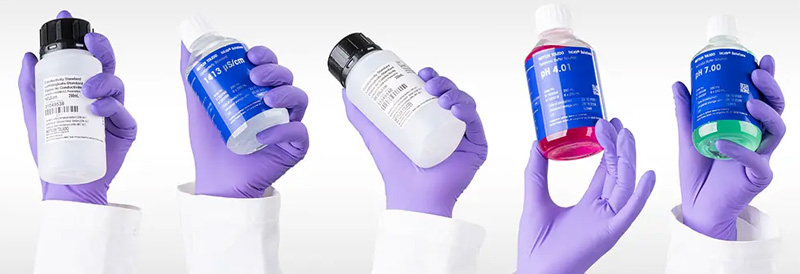
We often hear about the importance of accurate pH and conductivity measurements for ensuring the reliability and quality of various analytical processes. Ever wonder what makes those readings reliable? Central to achieving this accuracy is the proper calibration of pH and conductivity sensors using reference solutions known as buffers and conductivity standards which have precisely defined values. These calibration solutions, offered by numerous producers, come with specified quality levels that determine their measurement uncertainty.
Given that typical pH measurement errors range around ±0.05 pH units, any deviation from the stated uncertainty of these calibration buffers introduce additional, often unnoticed, errors into every pH measurement performed. This is why it is essential to use high-quality buffers that are traceable back to certified reference materials to maintain measurement integrity.
So, what exactly are these calibration solutions, and why do they matter so much?
pH Buffers
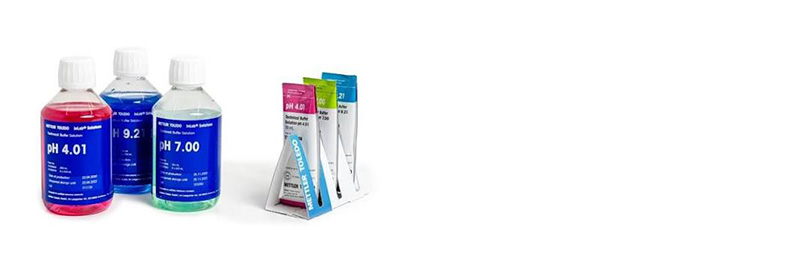
pH buffers are aqueous solutions that resist variations in pH levels when small amounts of acid or base are added. Every pH level corresponds to a specific buffer capacity and buffer range. This means that at a given pH, a buffer solution has a defined ability to resist changes in pH when acids or bases are added (buffer capacity), and it effectively maintains its pH within a certain range around that value (buffer range).
Buffer capacity describes how much acid or base can be added to the buffer before the pH starts to change noticeably. The larger the buffer capacity, the more resistant the solution is to changes in pH when substances are added.
Buffer range is the window of pH values where the buffer solution can work efficiently—outside this range, the buffer quickly loses its ability to resist pH changes.
Conductivity Standards
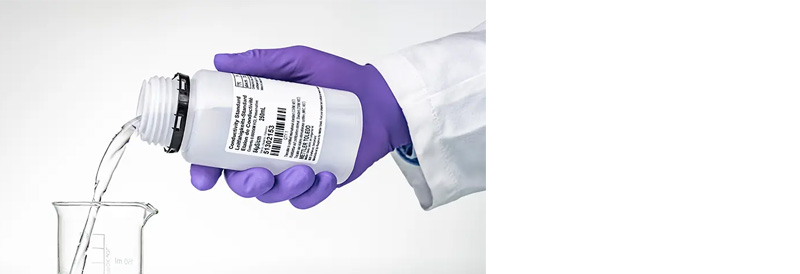
A conductivity standard is a reference solution of a known conductivity value that is used for sensor calibration or verification. Using the appropriate conductivity standard ensures accurate measurements. For calibration, higher conductivity standards are typically used to determine the cell constant of the sensor, while the low conductivity standards, which require special handling, are mainly used for verification purposes.
Where are calibration solutions used?
Calibration solutions are commonly used in various scientific and industrial applications for calibrating pH or conductivity sensors. At METTLER TOLEDO, pH buffers are available in two packaging formats: single-use buffer sachets or bottles of buffer solution. Some of the common applications are as follows:
Laboratory Research
Calibration solutions are essential in laboratory settings to ensure the accuracy and reliability of not only pH meters but also measuring instruments such as conductivity meters. By providing known reference values, these solutions help verify and adjust the instruments to produce precise measurements during experiments and analyses.
Quality Control in Manufacturing
In industrial manufacturing processes, calibration solutions are used regularly to maintain instrument performance, ensuring consistent product quality. Regular calibration helps detect instrument drift or malfunctions early, minimizing errors in measurements critical for production control.
Environmental Monitoring
Environmental laboratories use calibration solutions to confirm the precision of instruments measuring water quality, soil properties, and air samples. Accurate readings are vital for compliance with environmental regulations and assessing pollution levels.
Pharmaceutical
Buffers and solutions are crucial for maintaining the stability and efficacy of drugs during formulation and testing. Buffers help maintain the desired pH in drug formulations, ensuring the active ingredients remain stable and effective.
Food and Beverage Industry
In food processing, calibration solutions are used to ensure instruments measuring acidity, salinity, or other chemical properties deliver accurate results. This helps maintain product consistency, safety, and compliance with health standards.
What does METTLER TOLEDO offer when it comes to pH buffer solutions?
Be it technical buffers, certified buffers or NIST/DIN buffers, METTLER TOLEDO offers a complete portfolio of pH calibration solutions for any application.
Technical buffers come with a certificate from METTLER TOLEDO with a precision of ±0.02 pH units for most solutions.
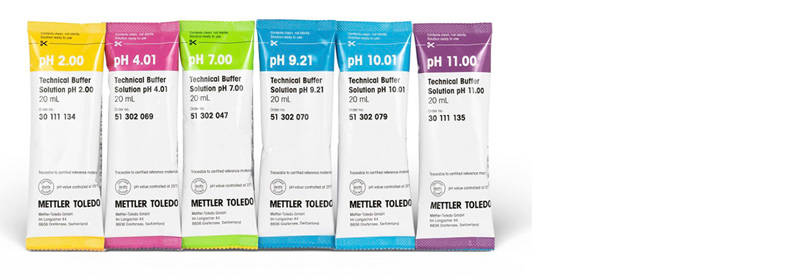
| Product Code | Supplier No. | Description | Unit Size |
|---|---|---|---|
10598281 | 51350002 | Technical Buffer pH 2.00 | 250 mL |
| 12601306 | 51350016 | Technical Buffer pH 2.00 | 6x 250 mL |
| 15339400 | 30111134 | Technical Buffer pH 2.00 | 30x 20 mL (sachets) |
| 10201841 | 51350004 | Technical Buffer pH 4.01 | 250 mL |
| 12611306 | 51350018 | Technical Buffer pH 4.01 | 6x 250 mL |
| 12663516 | 51302069 | Technical Buffer pH 4.01 | 30x 20 mL (sachets) |
| 17475559 | 30464188 | Technical Buffer pH 5.00 | 250 mL |
| 10683701 | 51350006 | Technical Buffer pH 7.00 | 250 mL |
| 12621306 | 51350020 | Technical Buffer pH 7.00 | 6x 250 mL |
| 12723161 | 51302047 | Technical Buffer pH 7.00 | 30x 20 mL (sachets) |
| 17224973 | 30464189 | Technical Buffer pH 8.00 | 250 mL |
| 10383191 | 51350008 | Technical Buffer pH 9.21 | 250 mL |
| 12631306 | 51350022 | Technical Buffer pH 9.21 | 6x 250 mL |
| 12137800 | 51302070 | Technical Buffer pH 9.21 | 30x 20 mL (sachets) |
| 10343291 | 51350010 | Technical Buffer pH 10.00 | 250 mL |
| 10422701 | 51350024 | Technical Buffer pH 10.00 | 6x 250 mL |
| 10431721 | 51302079 | Technical Buffer pH 10.01 | 30x 20 mL (sachets) |
| 10634091 | 51350012 | Technical Buffer pH 11.00 | 250 mL |
| 11962535 | 51350026 | Technical Buffer pH 11.00 | 6x 250 mL |
| 15395698 | 30111135 | Technical Buffer pH 11.00 | 30x 20 mL (sachets) |
| 10597571 | 51302068 | Rainbow sachets I (4.01 / 7.00 / 9.21) | 3x 10x 20 mL (sachets) |
| 12693516 | 51302080 | Rainbow sachets II (4.01 / 7.00 / 10.01) | 3x 10x 20 mL (sachets) |
| 15361034 | 30095312 | Rainbow bottles I (4.01 / 7.00 / 9.21) | 3x 2x 250 mL |
Certified buffers are verified and certified by DAkkS (Deutsche Akkreditierungsstelle, German Accreditation Body) accredited laboratory, with a precision of ±0.02 pH units. These buffers are traceable to a certificate of an accredited body of DKD (Deutscher Kalibrierdienst, German Calibration Service). These are measured according to ISO/IEC 17025.
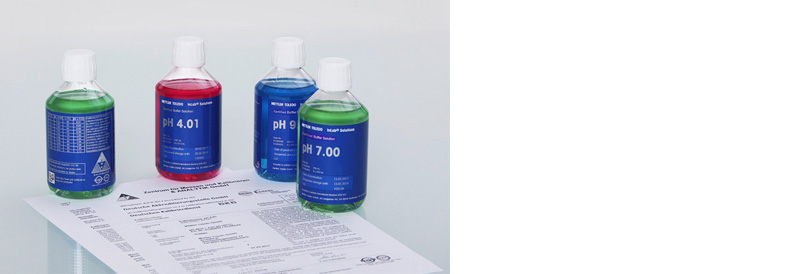
| Product Code | Supplier No. | Description | Unit size |
|---|---|---|---|
| 10238422 | 51350032 | Certified Buffer pH 4.01 | 250 mL |
| 10711765 | 51350042 | Certified Buffer pH 4.01 | 6x 250 mL |
| 10709883 | 51350034 | Certified Buffer pH 7.00 | 250 mL |
| 10711955 | 51350044 | Certified Buffer pH 7.00 | 6x 250 mL |
| 10533353 | 51350036 | Certified Buffer pH 9.21 | 250 mL |
| 10657243 | 51350046 | Certified Buffer pH 9.21 | 6x 250 mL |
| 10684863 | 51350038 | Certified Buffer pH 10.00 | 250 mL |
| 12651306 | 51350048 | Certified Buffer pH 10.00 | 6x 250 mL |
NIST/DIN buffers are prepared according to DIN/ISO 19266 and follow the recommendation of the National Institute of Standards and Technology and the German Institute of Standardization, with a precision of ±0.015 pH units.
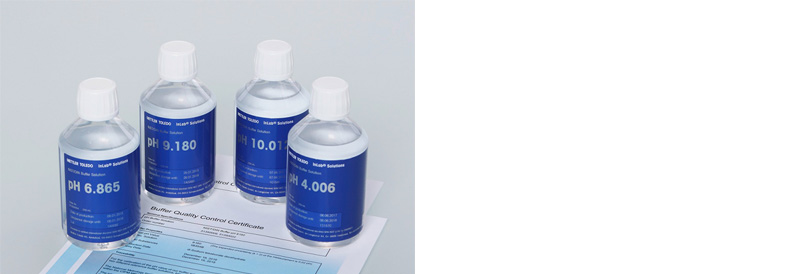
| Product Code | Supplier No. | Description | Unit Size |
|---|---|---|---|
| 17175681 | 30458274 | NIST/DIN Buffer pH 1.679 | 250 mL |
| 17555786 | 30667828 | NIST/DIN Buffer pH 1.679 | 30x 20 mL (sachets) |
| 12699235 | 51350052 | NIST/DIN Buffer pH 4.006 | 250 mL |
| 15392265 | 30111136 | NIST/DIN Buffer pH 4.006 | 30x 20 mL (sachets) |
| 10474071 | 51350054 | NIST/DIN Buffer pH 6.865 | 250 mL |
| 15312275 | 30111137 | NIST/DIN Buffer pH 6.865 | 30x 20 mL (sachets) |
| 12619245 | 51350056 | NIST/DIN Buffer pH 9.180 | 250 mL |
| 15322275 | 30111138 | NIST/DIN Buffer pH 9.180 | 30x 20 mL (sachets) |
| 10643131 | 51350058 | NIST/DIN Buffer pH 10.012 | 250 mL |
| 17803775 | 30111139 | NIST/DIN Buffer pH 10.012 | 30x 20 mL (sachets) |
| 17406633 | 30464127 | NIST/DIN Buffer pH 12.454 | 250 mL |
Conductivity standards including 5 µS/cm, 10 µS/cm, 84 µS/cm, 500 µS/cm, 1413 µS/cm, and 12.88 mS/cm can help with the calibration and verification of conductivity sensors. High conductivity standards are the ones with high ion concentration and the low conductivity standards are the ones having low concentration of ions. However, these standards tend to be affected by dilution, contamination, or the influence of CO2 when in contact with air; their values change readily, especially in the case of low conductivity standards. This is why a conductivity standard cannot be stored or used for an extended period after opening.
The 10 µS/cm, 1.3 µS/cm, 5 µS/cm standards are intended only for verification of a measurement near the pure water range as the values of lower conductivity standards are easily affected by any mishandling. On the other hand, the 84 µS/cm standard should be used for the best calibration accuracy.
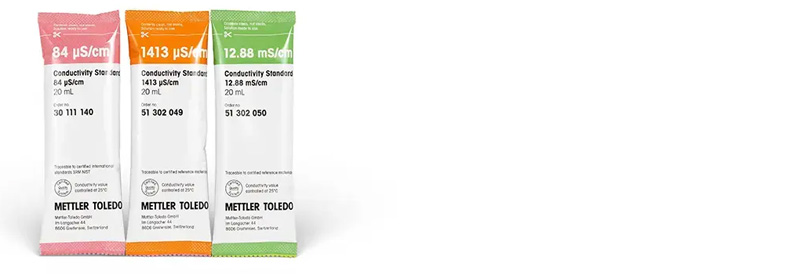
| Product Code | Supplier No. | Description | Unit Size |
|---|---|---|---|
| 15453033 | 30090847 | Conductivity Check Solution 1.3 µS | 250 mL |
| 15899657 | 30094617 | Conductivity Standard 5 µS | 250 mL |
| 10545284 | 51300169 | Conductivity Standard 10 µS | 250 mL |
| 11952535 | 51302153 | Conductivity Standard 84 µS | 250 mL |
| 11977501 | 51300170 | Conductivity Standard 500 µS | 250 mL |
| 10563762 | 51350092 | Conductivity Standard 1413 µS | 250 mL |
| 12601316 | 51350096 | Conductivity Standard 1413 µS | 6x 250 mL |
| 10166380 | 51302049 | Conductivity Standard 1413 µS | 30x 20 mL (sachets) |
| 10259351 | 51350094 | Conductivity Standard 12.88 mS | 250 mL |
| 12611316 | 51350098 | Conductivity Standard 12.88 mS | 6x 250 mL |
| 10528632 | 51302050 | Conductivity Standard 12.88 mS | 30x 20 mL (sachets) |

Related Products

Catalog Number 17570996

Catalog Number 31454066