missing translation for 'onlineSavingsMsg'
Learn More
Learn More
Invitrogen™ CD207 (Langerin) Monoclonal Antibody (eBioL31), eBioscience™, Invitrogen™
Rat Monoclonal Antibody
1586.00€ - 3585.00€
Specifications
| Antigen | CD207 (Langerin) |
|---|---|
| Clone | eBioL31 |
| Concentration | 0.5 mg/mL |
| Applications | Flow Cytometry, Immunohistochemistry (Frozen), Immunoprecipitation, Western Blot |
| Classification | Monoclonal |
Description
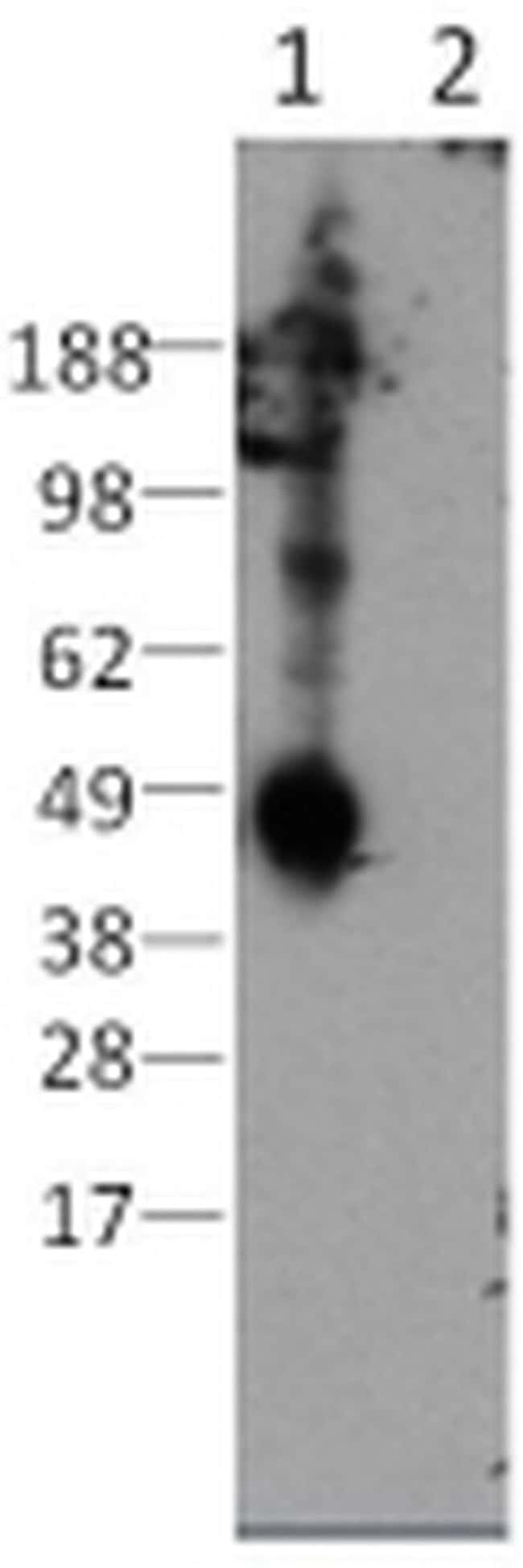
The eBioL31 MAb reacts with mouse CD207, also known as Langerin, which is expressed in a distinct subset of dendritic cells called Langerhans cells (LC). Mouse CD207 is a 48 kDa C-type lectin transmembrane protein that likely plays a role in antigen recognition and uptake. LC are located in the epidermis and upon activation, reduce CD207 expression and begin migrating through the dermis towards lymphatic vessels. Expression of mouse CD207 in LC has been correlated to the presence of Birbeck Granules. Furthermore, the formation of Birbeck Granules has been observed upon transfection of CD207 cDNA into fibroblast cell lines. Western Blotting with eBioL31 reveals a 48kDa band in lysate from mouse ear epidermis, as well as in lysates from cells transfected with mouse CD207 cDNA. Preliminary data from mouse CD207 cDNA transfected cells suggests that eBioL31 can be used for intracellular flow cytometric analysis in combination with the Foxp3/Transcription Factor Staining Bufer Set (cat. 00-5523). The epitope recognized by eBioL31 is in the extracellular domain within the CRD (carbohydrate recognition domain) and therefore can be used to detect both surface and intracellular langerin. Differences in expression has been observed between mouse strains.
Langerin (CD207) is a type II membrane-associated C-type lectin known to be expressed exclusively by Langerhans cells. Lamgerin recognizes mannose residues via its single carbohydrate recognition domain (CRD). Langerin is localized not only on the cell surface, but also intracellularly in close association with Birbeck granules. Transfection of Langerin cDNA into fibroblasts creates a compact network of membrane structures with typical features of Birbeck granules (BG). Langerin is thus a potent inducer of membrane superimposition and zippering leading to BG formation.Specifications
| CD207 (Langerin) | |
| 0.5 mg/mL | |
| Monoclonal | |
| Liquid | |
| RUO | |
| PBS with 0.09% sodium azide; pH 7.2 | |
| 246278 | |
| Primary | |
| 4°C | |
| CD207 |
| eBioL31 | |
| Flow Cytometry, Immunohistochemistry (Frozen), Immunoprecipitation, Western Blot | |
| Unconjugated | |
| Rat | |
| Mouse | |
| Q8VBX4 | |
| IgG2a | |
| Affinity chromatography | |
| Antibody |
Spot an opportunity for improvement?Share a Content Correction
Product Content Correction
Your input is important to us. Please complete this form to provide feedback related to the content on this product.
Product Title