missing translation for 'onlineSavingsMsg'
Learn More

Invitrogen™ Occludin Polyclonal Antibody

Code produit 10632194
Modifier l'affichage
Click to view available options
Quantity:
100 μg
Conditionnement:
100µg
1 product options available for selection
Product selection table with 1 available options. Use arrow keys to navigate and Enter or Space to select.
Code produit Quantity Conditionnement
10632194 100 μg 100µg
Use arrow keys to navigate between rows. Press Enter or Space to select a product option. 1 options available.
1 options
Les retours ne sont pas autorisés pour ce produit. Afficher la politique du retour.
Code produit 10632194 Fournisseur Invitrogen™ Code fournisseur 404700
  • ONLINE EXCLUSIVE PRICE
    510.00€
    438.65€ / 100µg
    Save 71.35€
    13% Off
Afficher toutes les promotions
 Restricted Item
In Stock
Ajouter au panier
Edge
Ajouter au panier

missing translation for 'validMainframeMsg'

Les retours ne sont pas autorisés pour ce produit. Afficher la politique du retour.

Rabbit Polyclonal Antibody

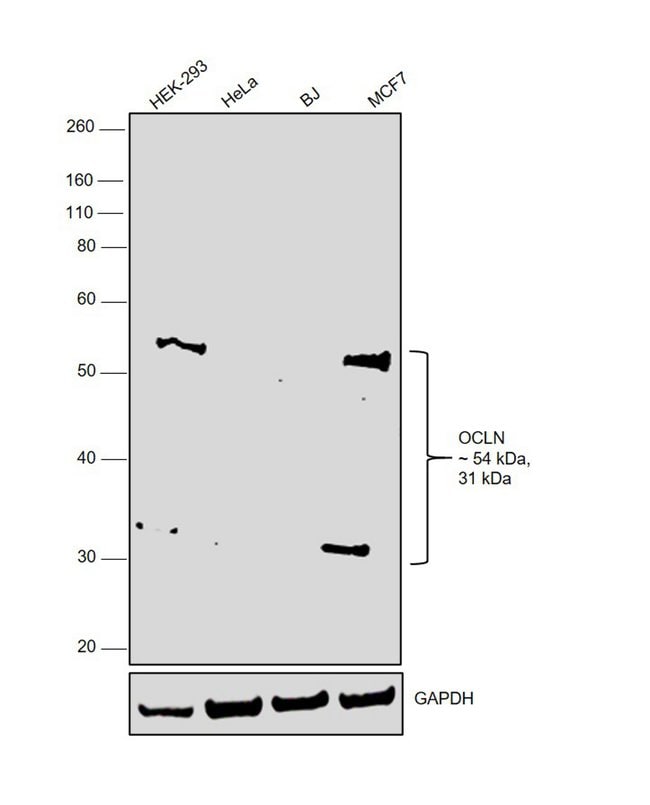
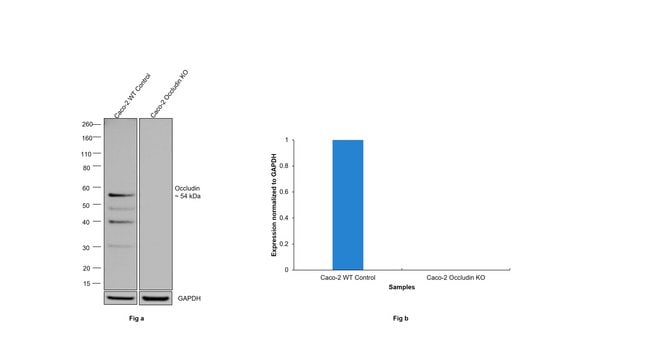
This antibody is specific for the human occludin protein. On western blots, it identifies the target band at ~65 kDa. Reactivity has been confirmed with human Caco-2 and HT29, dog MDCK, mouse TCMK, and rat KNRK cell lysates, and mouse kidney, liver, and rat liver homogenates by western blotting, Caco-2 cells by immunofluorescence, and paraffin-embedded human small intestine tissue by immunohistochemistry. For immunofluorescence using Caco-2 cells, fixation with cold ethanol is recommended. For immunohistochemistry in paraffin-embedded tissues, enzyme digestion with pepsin is required prior to staining.

Occludin is a 65 kDa protein that can exist in a variety of phosphorylated forms, ranging up to approximately 82 kDa. Occludin is thought to be involved in regulating both the localization and the function of occludin. Polyunsaturated fatty acids are known to up-regulate occludin expression, increasing the transendothelial cell resistance and reducing the cellular permeability to large molecules. The level of occludin varies greatly depending on tissue; in brain tissue, occludin is highly and continuously expressed at cell-cell contact sites, whereas non-neural tissues show lower expression and discontinuous distribution. Overall structural features of the occludin protein are highly conserved in all the species examined. Under-expression of tight junction proteins, including occludin, is a key molecular abnormality responsible for the increased permeability of tumor endothelial tight junctions, which contributes to brain tumor edemas.
TRUSTED_SUSTAINABILITY

Spécification

Antigen Occludin
Applications Immunohistochemistry (Paraffin), Western Blot, Immunocytochemistry
Classification Polyclonal
Concentration 0.25 mg/mL
Conjugate Unconjugated
Formulation PBS with 0.1% sodium azide; pH 7.4
Gene OCLN
Gene Accession No. Q16625, Q28269, Q61146, Q6P6T5
Gene Alias AI503564; BLCPMG; Occludin; occludin 1B; Ocl; Ocln; phosphatase 1, regulatory subunit 115; PPP1R115; tight junction protein occludin; tight junction structural protein
Gene Symbols OCLN
Host Species Rabbit
Immunogen Synthetic peptide derived from the C-terminal region of the human occludin protein.
Purification Method Antigen affinity chromatography
Quantity 100 μg
Regulatory Status RUO
Primary or Secondary Primary
Gene ID (Entrez) 100506658, 18260, 403844, 83497
Target Species Canine, Human, Mouse, Rat
Content And Storage -20°C
Product Type Antibody
Form Liquid
Isotype IgG
Afficher plus Afficher moins
Nom du produit
Sélectionnez un problème

En cliquant sur Soumettre, vous reconnaissez que vous pouvez être contacté par Fisher Scientific au sujet des informations que vous avez fournies dans ce formulaire. Nous ne partagerons pas vos informations à d'autres fins. Toutes les informations de contact fournies seront également conservées conformément à notre politique de confidentialité. Politique de confidentialité.